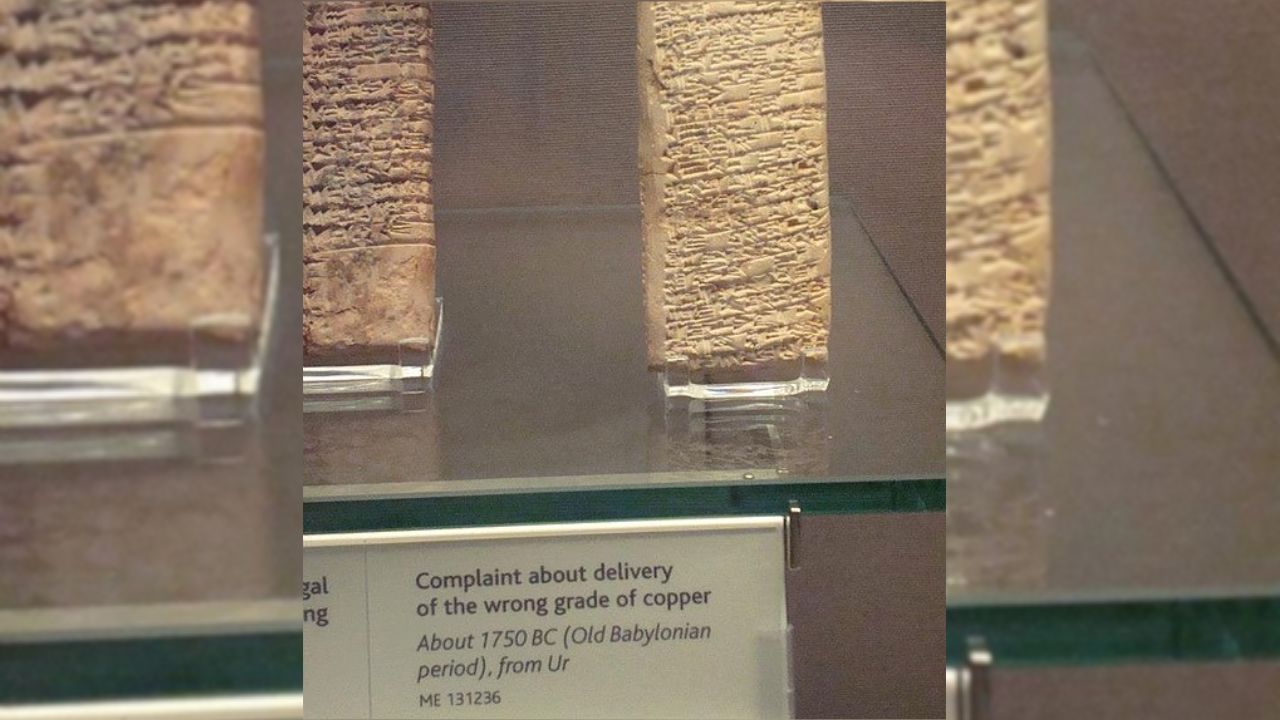
The Oldest Recorded Customer Complaint
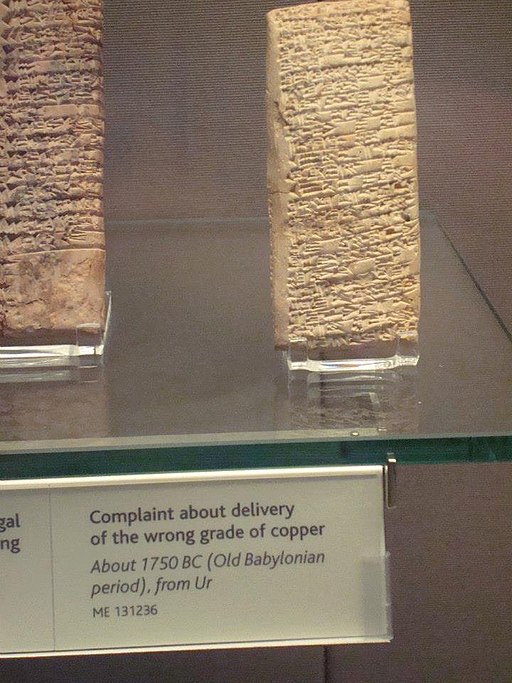
This clay tablet from ancient Babylon was written in about 1750 BC and is the world’s oldest recorded customer complaint.
The “Complaint Tablet To Ea-Nasir” records in cuneiform a complaint to a merchant named Ea-Nasir from a customer named Nanni. Ea-Nasir traveled to the Persian Gulf to buy copper and then sold it in Mesopotamia.
One of his customers was Nanni, who sent his servant with the money to buy the copper and complete the transaction. The copper was sub-standard and not acceptable to Nanni.
Nanni formally documented his complaint on a clay tablet in cuneiform writing and sent it to Ea-Nasir. Inscribed on the tablet is the complaint about a copper delivery of the inferior grade.
He also complained that his servant, who handled the transaction, had been treated rudely.
The tablet reads:
“Tell Ea-Nasir: Nanni sends the following message:
When you came, you said to me: “I will give fine quality copper ingots.”
You left, but you did not do what you promised me.
You put ingots which were not good before my messenger and said:
“If you want to take them, take them; if you do not want to take them, go away!”
What do you take me for that you treat me with such contempt? …
… How have you treated me for that copper?
You have withheld my money bag from me in enemy territory;
it is now up to you to restore to me in full.
Take notice that I will not accept any copper from you that is not of fine quality.
I shall select and take the ingots individually in my yard,
and I shall exercise against you my right of rejection because you have treated me with contempt.”
The “Complaint Tablet To Ea-Nasir” was found in the ruins of Ur inside an old Babylonian house, which may have been the residence of Ea-Nasir.
Ur was the largest city in the world from c. 2030 to 1980 BC. Its population was approximately 65,000. Ur fell around 1940 BC to the Elamites.
Cuneiform
Cuneiform was one of the earliest systems of writing, invented by Sumerians. Its wedge-shaped marks are made using a blunt reed for a stylus on wet clay tablets which are then baked to a solid tablet.
The term cuneiform comes from the Latin word for “wedge.” Cuneiform emerged in Sumer in the late fourth millennium BC as a system of pictograms.
In the third millennium, the pictorial representations became simplified and more abstract as the number of characters in use grew smaller.